The question that comes up in every honest first conversation with a retiring principal is not "what is my book worth?" That one has a defensible answer in numbers. The harder question is "what happens to the people I have worked alongside for twenty years?"
The answer depends on who buys you. The consolidator integration playbook produces a fairly recurring set of staff outcomes; the broker route is a roll of the dice with whoever turns up; what we commit to in the SPA, as a direct buyer, is below.
The consolidator integration playbook
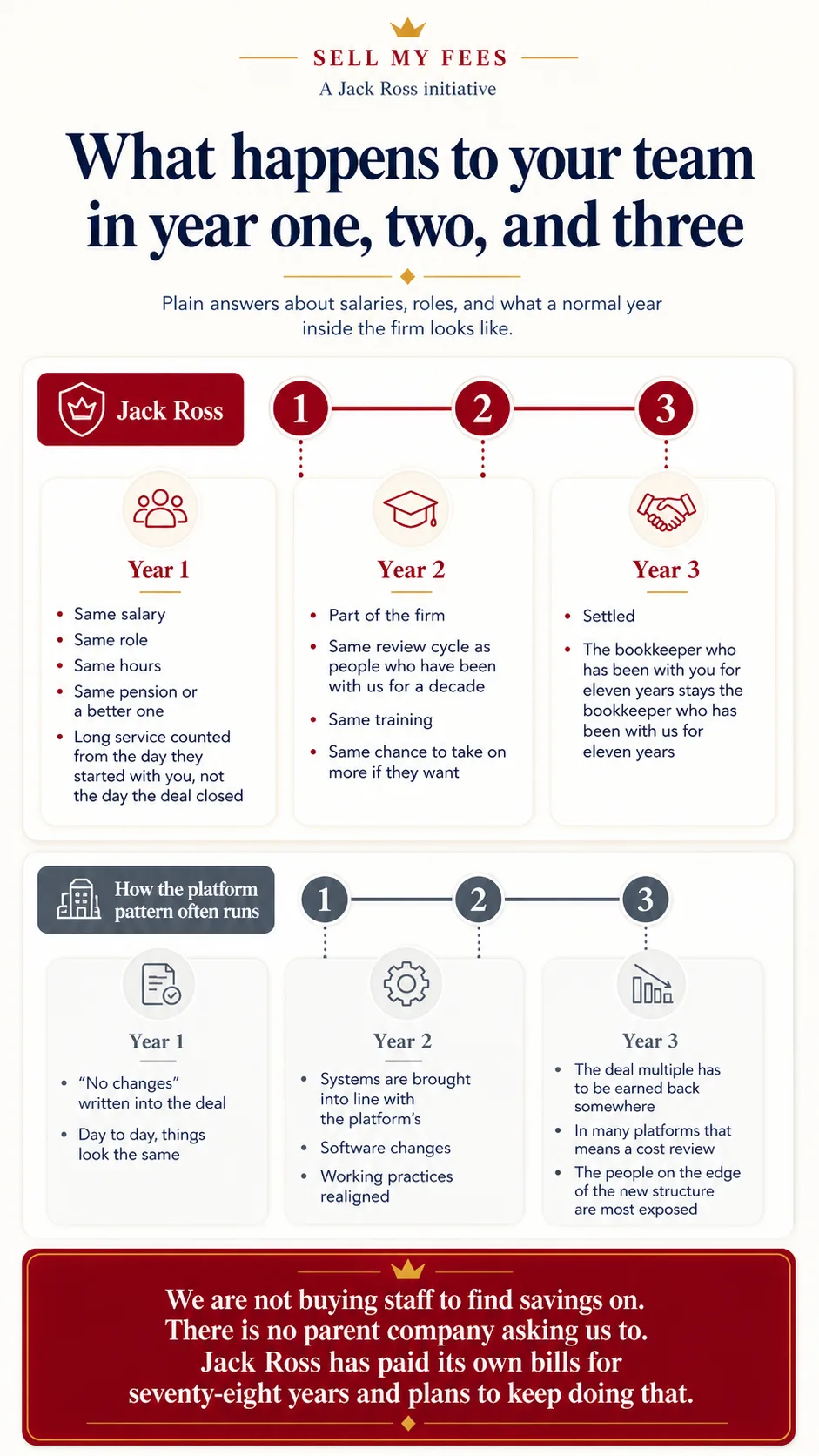
Industry commentary on the larger consolidators points to a recurring sequence. Year one is "no changes", written into the deal documentation. Year two is systems integration. By year three, in many integration models, the cost review is where staff risk becomes more visible. Outcomes vary by acquirer, by deal size, and by the specifics of the absorbed firm. The structural logic of the platform model creates the conditions for it: the savings the deal multiple was based on have to come from somewhere, and absorbed staff tend to be most exposed.
This is not a moral failing of the consolidators. It is the structural logic of their model. PE money has a return clock. The clock runs out at year four or five. Costs come down to lift EBITDA before the next sale or refinancing. The people who joined under acquired-firm employment contracts have less institutional protection than the original platform staff, almost by definition.
If your staff are a priority, the PE route has structural risks that are not visible at deal time. They become visible at year three.
The broker route
A broker does not choose the buyer's culture. The broker introduces. What happens to your staff depends entirely on who turns up to the introduction.
Some buyers are decent. Some are not. The broker's incentive is to close a deal at a fee, not to optimise for staff outcomes you have not asked them to optimise for. If you tell a broker "this only works if my team is protected", they will hear it and pass it on. They cannot enforce it.
If staff continuity is the priority, the broker route is a roll of the dice with the buyer pool the broker happens to have on their list this quarter.
What we do differently, and why we can
Jack Ross is built to absorb a small acquired practice without internal restructuring. The firm operates with deliberate headroom, in people and in capital, so the team that walks in with the deal does not displace anyone already here. We are not running a consolidation strategy with promised cost savings to deliver. We are a chartered firm that needs more hands to keep up with the work we already have on the desks.
That difference in structure is why we can commit to what we commit to. We do not have a PE shareholder to satisfy. We have room to take on more work, we have the cash on the balance sheet to fund the deal ourselves, and we have no investor timetable driving cost-cutting in year three.
It is because the structure of our firm allows us to do this without restructuring, and the structure of a PE-backed platform does not allow them to do this without restructuring.
What we will commit to in writing
Specific clauses, written into the SPA before signing:
- Year one for your team. We are buying space in the firm, not buying ourselves a cost-cutting project. Jack Ross has room for several more people right now, and your team fills that room. The SPA records what we are telling you here in plain words: no redundancies in the first twelve months as a way to reduce costs. The carve-outs are the ones any decent employer keeps in reserve, serious conduct, a performance issue that does not improve after a proper conversation, or something unexpected in the wider business. They have to be there because nobody can write an absolute employment guarantee that survives every possible event. What you are getting is a buyer who is not setting out to find savings on the people who walked in with the deal.
- Salary parity. Your team move across at their existing salary. They join the standard Jack Ross annual review cycle the following year, alongside our existing staff, on the same terms.
- Role continuity. A senior person stays a senior person. We do not grade everyone down to "team member" on transition. Job titles are preserved at the same seniority unless the individual prefers a change.
- Pension continuity. Either continuation of your existing scheme or transfer to ours, whichever is better for the individual. We will pay any uplift difference for the first 12 months if the transfer creates a gap.
- Holiday accrual. Carries over. Long-service entitlement is recognised from original start date, not transfer date.
- Professional Indemnity cover. Continues seamlessly under our practice cover from completion. No gap, no run-off cost passed on to the staff member.
- Training and development. Your team gain access to our internal CPD programme, our ICAEW-funded training budget, and the Jack Ross Academy from week one.
- Direct line to the Managing Partner. Our Managing Partner is reachable on a direct line through year one for any team member who has a problem with how the transition is going.
The SPA you would sign with us has these as binding clauses. They are not in the marketing column of a comparison page; they are in the document itself. You can have your solicitor mark them up before signing.
If staff continuity is the priority that drives the deal, the right next step is a 15-minute confidential call to talk through your specific situation. Book a call. Mutual NDA available on request before any substantive conversation.
If your team is two or three people
Most of the practices we look at have a small support team: a senior accountant, a bookkeeper, perhaps a part-time receptionist or client manager. A three-person support team is not treated as a cost-saving target on the way in. In a small practice the senior accountant and bookkeeper usually carry much of the client memory between them, and losing either damages year-two retention. Our commercial interest is to keep them settled, paid on existing terms, and recognised at their existing seniority. The 12-month no-redundancy commitment exists because the deal works only if those people stay.
What we ask in return
The transition needs your team to engage with us. Specifically, in the 12-week run-up to completion and through the first 12 weeks after, we need:
- Honest information about who does what, how the practice runs operationally, and which clients each person owns or has the deepest relationship with.
- Professional cooperation through the handover. Joint client meetings where appropriate. Introductions to suppliers, software vendors, the bank, the landlord.
- Open conversation about which staff want to stay, which are themselves planning to retire, which are on the fence. We make better decisions about the deal when we know.
After the first 12 months, your team are Jack Ross people, and they are treated like Jack Ross people. The same rules apply, the same review processes, the same career paths. The difference between "absorbed staff" and "original staff" stops mattering and we genuinely don't track it.
What year two actually looks like
Beyond month twelve, nobody, including us, can promise lifetime employment to anyone. What we can tell you is how the firm runs day to day, because that is what your team will live inside.
By the start of year two, the people who came across with the deal are simply part of the team. They sit in the same review cycle as everyone else. They have the same conversations about workload, training, and progression that we have with the people who have been with us for ten years. The bookkeeper who has been with you for eleven years stays the bookkeeper who has been with us for eleven years; the long service is the same, the recognition is the same.
What does not happen in year two is the thing the platform model produces. We do not have a parent company asking us to find savings to keep an investor happy. We do not have a debt facility that needs servicing through staff costs. The firm pays its own bills out of the work it actually does, and we plan to keep doing that. So when month thirteen arrives there is no spreadsheet exercise looking for posts to remove. There just is not one.
If something does go wrong with an individual, and that happens in any team, it is dealt with the way you would have dealt with it. A conversation first. A real attempt to fix whatever the issue is. Proper notice if it cannot be fixed. Treated like a person, not a line item. We do all of that for the staff who have been with us for years, and we will do exactly the same for the staff who have just joined.
A worked example (illustrative)
An illustrative example, drawing on our own experience, our wider M&A practice, and the published patterns from comparable acquisitions in the sector. Marked clearly as illustrative.
Illustrative example. A two-partner practice with a five-person team (one senior accountant, two qualified accountants, one bookkeeper, one client manager) joins Jack Ross. Day one of completion: existing employment contracts continue, salaries unchanged, pension scheme either continues or transfers within 60 days. Week one: each member of the team has a one-on-one with our Managing Partner in their existing office. Week two through twelve: the senior accountant and Jack Ross's existing senior accountant pair up on the largest client accounts, with the seller's senior leading on relationship and the Jack Ross senior shadowing on technical handover. Month three: the absorbed team is on the standard Jack Ross internal communication channels, training calendar, and weekly partner meeting summary. Month six: appraisals run on the Jack Ross calendar with the seller's prior performance assessments referenced. Year one anniversary: salary review on the Jack Ross cycle. Year two: the structure is one firm, no distinction between absorbed and original.
The points of friction in a deal of this kind are usually the boring administrative ones (payroll software switchovers, holiday calendar reconciliation, expense process changes), not the cultural ones, provided the deal is structured around staff continuity from the start.
Questions you will want to ask us
Tell us early. We work it through. The options are: structured retirement on the same date as the deal, with a settlement; staying for an agreed handover period of three to six months; or coming across and reconsidering after the first review cycle. We have done all three across our wider hiring history. The earliest you raise it, the more options stay open.
Comes across on the same hours, same rate. Part-time bookkeeping is a normal part of how the firm runs.
It depends on the lease and the geography. If your office is within reasonable distance of central Manchester and the lease is renewable on sensible terms, often yes for the first 12 to 24 months because client continuity and staff stability both benefit. If the lease is expensive and you are already considering not renewing, we work to your timetable, not against it. The decision is part of the deal negotiation, not a unilateral one we make later.
The year-one position is in the SPA. If a real issue does come up with someone in those first months, we handle it the way you would have done. A proper conversation. A chance to fix it. Notice if it cannot be fixed. For the first six months any of those conversations are run jointly with you so nothing happens behind your back. The intent is simple: we want your team across, settled, and able to do the work.
Direct line to the Managing Partner. We do not delegate the first 12 months of these calls.
Often the cleanest answer is a co-ordinated retirement at the same time as the principal's, with proper pension arrangement and a settlement that recognises long service. We have run this for our own staff and we run it the same way for absorbed staff.
The next step
If staff continuity is the worry that has been keeping you up at night, the conversation we should have is exactly that one. The first call is 15 minutes. We will tell you, on that call, what we commit to in writing in any acquisition we lead. No NDA is needed for the first call unless you would prefer one in advance; if so, ask in your first email and the one-page mutual NDA is sent across.
Related reading
- Your clients should barely notice the difference - Pillar 2: client retention through the deal.
- A clean structure, not a leveraged earn-out - Pillar 3: 50/25/25 structure with worked examples.
- Twelve weeks. A clean exit. A defined finish line. - Pillar 4: the week-by-week sequence.
- How to sell your accountancy practice in the UK - overview of the realistic exit routes.