** WARNING: connection is not using a post-quantum key exchange algorithm.
** This session may be vulnerable to "store now, decrypt later" attacks.
** The server may need to be upgraded. See https://openssh.com/pq.html
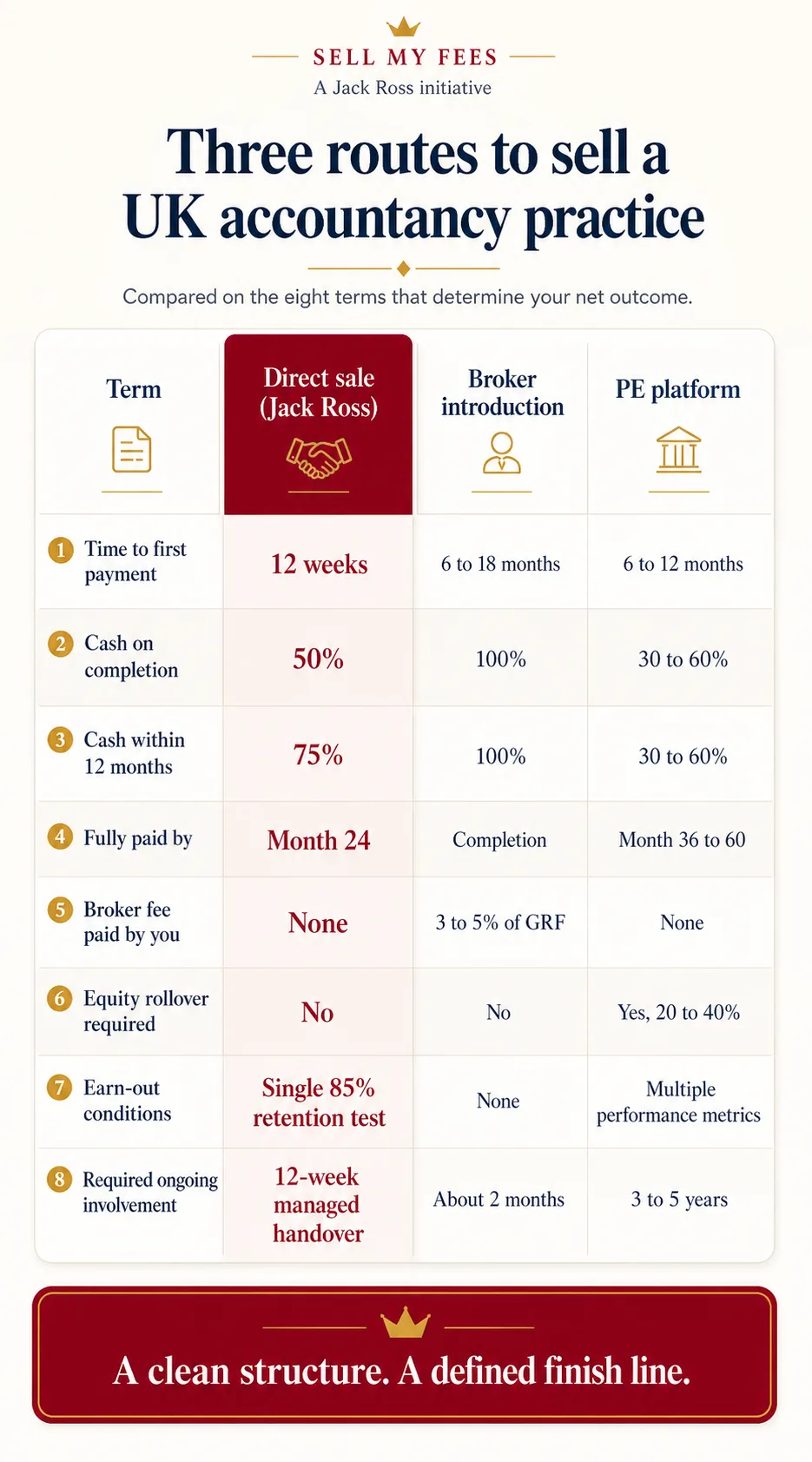
The market as it stands
The UK accountancy consolidation wave has produced two visible exit routes for sole practitioners and small firms. Brokers and PE-backed platforms.
For a side-by-side comparison of the two main alternatives - brokers and PE consolidators - see accountancy practice broker vs direct buyer and private equity vs trade buyer.
Brokers (Foulger Underwood, Vivian Sram, Robertson Hare, Kingsman, Evolve, and a long tail of smaller introducers) operate on commission. They take a percentage of the deal value, typically three to five per cent of gross recurring fees, paid by you on completion. Their incentive is to close any deal, not necessarily the right deal for you. The good ones are good. The structure is what it is.
PE consolidators (Xeinadin, Azets, Sumer, TC Group, Dains, DJH, AAB, Cooper Parry, S&W, and others) buy at higher headline multiples, but the structures are designed for their internal economics, not yours. Earn-outs of three to five years. Clawback on multiple conditions. Equity rollover into the platform. Forced systems migration in year one or two. Staff restructuring against integration targets in year two and three. Both routes work. Both are legitimate. Neither is what every retiring principal actually wants.
The third route
Sell directly to a chartered firm with capacity to absorb your book. No broker fee. No PE machinery. A named acquirer you have shaken hands with. A commercial structure simple enough to summarise in a single page. A timeline you set.
This used to be the standard route until consolidation reshaped the market. It still works. We do it. So do a small number of other regional firms across the country. The reason it isn't more visible is that nobody markets it. There is no broker pushing it. No PR firm announcing it. We are trying to fix that, at least for our part of the country.
Who we are and why we buy
Jack Ross was founded in Manchester in 1948 and has been continuously practising since. We are an independent chartered firm working across audit, tax, advisory, and cloud accounting, regulated by the ICAEW. We are not a personality-led practice and we are not for sale ourselves.
Why do we buy? Because the work fits, and the capital is there. The firm operates with deliberate headroom, in people and in capital, so absorbing a small acquired book is the business we are already in, not a project we have to staff up for. The capital to fund the 50 per cent completion payment and the two deferred tranches sits within the firm itself, not on a PE platform's revolving credit line.
What we are not is in the consolidation business. There is no PE board telling us to find another deal this quarter, and we have no internal target to spend money against. We buy when a practice fits us and when we have the people and the money ready to do the deal well. Both are in place at the moment, and we are looking now.
What we offer that the alternatives do not
Concrete commitments, not aspirations:
- No broker fee. We are the buyer. There is no intermediary taking a cut.
- A named institutional buyer. The buyer in any SPA is Jack Ross Chartered Accountants, an ICAEW-regulated firm with an address, a phone number, and a long-established track record. The Managing Partner who signs the SPA is the same person you meet at the first conversation.
- Transparent structure. 50 per cent on completion, 25 per cent at month 12, 25 per cent at month 24. Heads of terms in plain English, the full SPA reviewed line by line by both solicitors. You see the commercial terms before any commitment.
- Defined timeline. 12 weeks from first conversation to first payment. We have run this sequence before; it is not an experiment.
- No PE-style year-three cost review. The pattern many integration models follow is "no changes year one, systems integration year two, cost review year three". We are not running that programme. Your team comes across, joins our team, and that is the operating assumption from year one through year five.
- Client continuity. We retain your communication style for twelve months. No forced cloud migration. If your clients are on QuickBooks or Xero, they stay there.
- Tax structuring assistance. We are a tax practice. We help you structure the sale tax-efficiently within ICAEW guidance. (Subject to your individual circumstances; we recommend you take independent advice.)
Everything in the structure above is set out in detail across this site: /deal-structure/, /transition-timeline/, illustrative end-to-end acquisition, valuation calculator. The mutual NDA is one page, available on request before any substantive conversation. Jack Ross is a UK-incorporated chartered firm; statutory accounts are filed at Companies House and verifiable directly by any seller.
What we look for
The kinds of practice we are most interested in talking to:
- General-practice books with substantial recurring revenue (60 per cent or more recurring is typical, though not a hard floor)
- Audit-led books (statutory audit of private companies, charity audit, pension audit, and SRA solicitor-firm audit). Audit is a genuine Jack Ross specialism: we run an active audit practice and the SRA solicitor-audit work goes through our sister site auditgroup.co.uk. Audit registration and capacity are in place.
- Tax-led books (HNW personal tax, OMB tax planning, niche tax specialisms)
- Advisory-led books (M&A support, valuations, business advisory for owner-managed businesses)
- Annual fees broadly in the £150k to £1m range
- Greater Manchester, East Lancashire, Cheshire, and parts of West Yorkshire are our home territory; outside that, talk to us first
- Principals who genuinely want to retire, not those who want to keep working under a new umbrella
If your book sits outside one or more of these typical points, that is a conversation, not a closed door. The first call is fifteen minutes and there is no commitment to anything.
What happens next
If you are curious, the next step is a 15-minute confidential call. We sign a mutual NDA first if you would prefer; the document is downloadable from the contact page below. The call is just a call. There is no commitment to anything afterwards.
About a third of first calls turn into a second meeting. About half of second meetings turn into heads of terms. Most heads of terms do not turn into completed deals. The ones that do are the ones where the fit is genuinely right for both sides.
The whole process is reversible until completion. There is no broker chasing close, no consolidator quota driving urgency, no PE board pushing for signature. The only timing pressure is the one you choose to set.
Related reading
- Your staff are not a redundancy line item to us - the staff-continuity commitments written into our standard SPA.
- Your clients should barely notice the difference - what happens to client relationships through the deal.
- A clean structure, not a leveraged earn-out - 50/25/25 with worked examples and tax structuring.
- Twelve weeks. A clean exit. A defined finish line. - the week-by-week sequence.
- Accountancy practice for sale (UK): three buyer routes - listings sites, PE consolidators, direct chartered firms compared.
- Get an indicative valuation range - interactive calculator, five data points, instant defensible range with the 50/25/25 cashflow.